Wildebeest Migration Kenya 2026: The Ultimate Guide to the Great Migration
The Great Migration isn’t a scheduled performance you can simply book like a theater ticket; it’s a raw, thundering pulse of the earth that follows the rains rather than the clock. If you’re planning to witness the wildebeest migration Kenya offers in 2026, you’ve likely felt that familiar pull of wonder mixed with a nagging anxiety about getting the timing exactly right. You want to see the golden dust clouds and hear the frantic splashes at the Mara River, but the fear of arriving a week too late or being lost in a sea of tourist vehicles is real.
It’s natural to feel a bit lost when trying to distinguish between the vast plains of the Serengeti and the intimate reaches of the Masai Mara. This guide replaces that confusion with the grounded expertise of a local mentor. You’ll discover the precise seasonal shifts for 2026, the quietest corners for an authentic experience, and the insider strategies needed to secure a front row seat to nature’s most spectacular event. We’ll walk you through the migration cycle month by month, from the first arrivals in July to the dramatic river crossings that define the Kenyan summer, ensuring your journey is as seamless as it is breathtaking.
Key Takeaways
- Grasp the true magnitude of the wildebeest migration Kenya and why the Masai Mara serves as the most dramatic stage for this circular journey.
- Uncover the primal instincts, including specific soil nutrients and rain patterns, that dictate every step the herds take across the plains.
- Identify the optimal 2026 windows for witnessing river crossings, specifically during the high-activity months of August and September.
- Gain the insider knowledge needed to navigate the Mara River’s crossing gates with the patience and timing of a seasoned safari guide.
- Learn how choosing a Kenya Wilderness Safari allows you to trade the crowds for seclusion, focusing on an authentic and deeply personal wildlife encounter.
What is the Wildebeest Migration in Kenya?
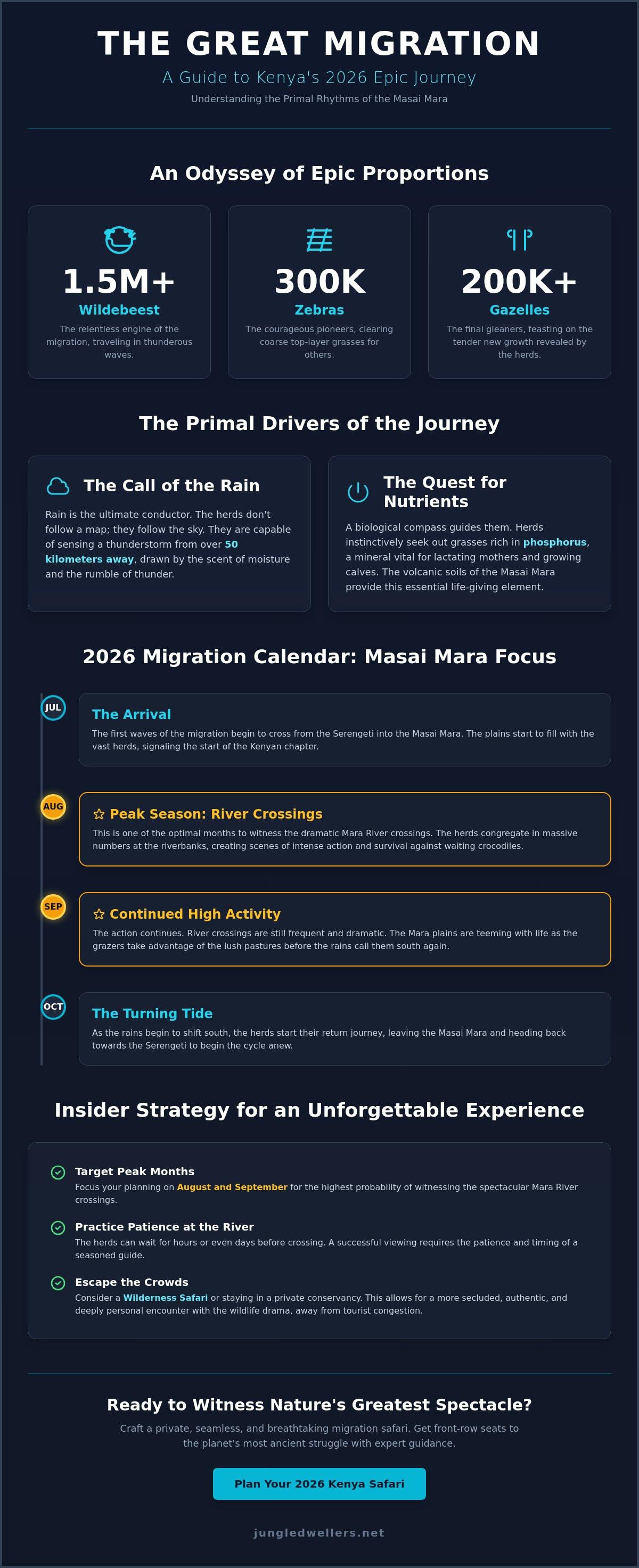
The earth literally vibrates when the herds arrive. This isn’t just a seasonal event; it’s a perpetual, circular odyssey involving over 1.5 million wildebeest, 300,000 zebras, and hundreds of thousands of gazelles. While the journey spans the entire Serengeti ecosystem, the wildebeest migration Kenya hosts represents the most intense chapter of this survival story. It’s a relentless pursuit of life, driven by a primal need for fresh water and green pastures that leads the herds across treacherous terrain and through the jaws of waiting predators.
In Kenya, the spectacle centres on the Masai Mara National Reserve and its surrounding private conservancies. This is where the “Main Event” unfolds. Witnessing the wildebeest migration Kenya offers is a lesson in the unyielding persistence of life. The world watches as the herds confront the Mara River, a barrier filled with some of the largest Nile crocodiles on the continent. It’s a scene of organized chaos, where instinct and desperation collide in a spectacular display of nature’s raw power. This is more than a wildlife sighting; it’s a front-row seat to the planet’s most ancient struggle.
The Three Key Players of the Plains
The migration isn’t a solo act; it’s a choreographed sequence of grazing that benefits the entire landscape. Each species plays a vital role in maintaining the health of the savannah through a process called grazing succession.
- Zebras: These are the courageous pioneers. They possess a digestive system capable of processing the tall, coarse, and dry grass that other animals find unpalatable. By clearing the top layer, they expose the more nutritious growth beneath.
- Wildebeest: Following closely behind the zebras, these “follow-the-leader” masses move in thunderous waves. They prefer the shorter, greener shoots revealed by the zebras, consuming vast quantities to sustain their energy for the long trek.
- Gazelles: As the final members of the procession, gazelles act as the gleaners. They focus on the tender new growth and delicate herbs that emerge after the heavier grazers have moved on.
Why the Masai Mara is the Final Destination
By the time the dry season grips the region, the Masai Mara becomes a vital sanctuary. Because the northern reaches of the ecosystem receive higher rainfall than the southern plains, the Mara remains a lush oasis when other areas have withered. The specific phosphorus levels in the soil here dictate the herd’s movement, as the animals instinctively seek out these mineral-rich grasses to build the bone strength and muscle needed for survival. This nutrient density provides the strength they need to nurse their young and survive the journey before they eventually turn south to begin the cycle once more.
The Rhythm of the Savannah: How the Migration Works
Rain is the ultimate conductor of this ancient orchestra. The animals don’t rely on a map or a human calendar; they follow the sky. They can sense a thunderstorm from over 50 kilometers away, responding to the low-frequency rumble of thunder and the scent of moisture on the breeze. When planning your migration safari, it helps to understand that you’re tracking a weather system as much as a herd. The air thickens with the scent of petrichor, and suddenly, a million animals turn as one toward the horizon.
The herds are biologically driven to seek out high phosphorus levels in the grass, a mineral essential for lactating mothers and growing calves that acts as a silent compass across the plains. This nutritional need is so powerful that calves born in the southern Serengeti instinctively know to begin a 500-mile trek north just weeks after birth. It’s a staggering feat of inherited memory. Instinct guides the wildebeest migration Kenya sees each year, ensuring the next generation finds the life-giving minerals found only in the Mara’s volcanic soils.
Predators are well aware of this rhythm. Lions, leopards, and hyenas don’t follow the herds over long distances; they wait. Each pride has a territory, and they simply bide their time until the “moving feast” arrives at their doorstep. This creates a high-stakes environment where the tension is almost palpable. If you’re looking for a more intimate way to experience these predator-prey dynamics, a Kenya Wilderness Safari can position you in secluded areas where the drama unfolds without the distraction of other vehicles.
Environmental Triggers for 2026
Climate patterns in East Africa are becoming increasingly fluid. For 2026, shifting rainfall suggests that the traditional arrival dates may fluctuate by several weeks. While we expect the herds to cross into Kenya by late July, a delayed rainy season could push the peak activity further into August. Conversely, the arrival of the “Short Rains” in late October or November acts as the signal for the herds to begin their journey back south. We monitor these clouds daily to ensure our guests are always in the right place at the right time.
The Survival Instincts of the Herd
There is a beautiful, chaotic intelligence in how the herd moves. They employ a “swarm intelligence” where no single animal is in charge, yet the mass moves with singular purpose. Cooperation is also key to their survival. Zebras and wildebeest travel together because they complement each other’s senses. Zebras have excellent eyesight to spot predators in the distance, while wildebeest have an acute sense of hearing and smell. Together, they form a formidable defensive unit against the shadows lurking in the tall grass.
Timing Your Journey: The 2026 Migration Calendar
Nature doesn’t keep a diary. While the herds are in constant motion, their presence in Kenya is a distinct chapter of the year that requires careful planning to witness. For the 2026 season, we anticipate the pulse of the wildebeest migration Kenya to follow a rhythmic progression from the southern borders to the northern reaches of the Mara.
- July: The Arrival. The first scouts usually reach the Sand River by mid-month. As the Serengeti plains dry out, these pioneers lead the way into the southern Masai Mara, bringing a sense of electric anticipation to the landscape.
- August & September: Peak Crossing Season. This is the heart of the action. During these months, the most frequent and dramatic river crossings occur at the Mara and Talek rivers. The herds are at their most concentrated, and the air is thick with the sound of bleating and the scent of dust.
- October: The Green Flush. The pressure at the riverbanks begins to ease. The herds spread out across the northern plains and private conservancies, taking advantage of the lush grass before the cycle turns again.
- November: The Departure. The “Short Rains” in the south act as a silent siren song. The herds begin a rapid, purposeful trek back toward the Serengeti, often moving much faster than they arrived.
July to August: The Dramatic Entry
The dust settles on the first wave. This period marks the transition from the vast Serengeti to the intimate hills of the Mara. We’ve found that early August is often the most sought-after window for our US travelers. It aligns perfectly with summer breaks and offers the highest statistical probability of seeing a major river crossing. During these weeks, the energy of the savannah is at its peak. You’ll see massive columns of wildebeest stretching to the horizon, all moving with a singular, desperate focus toward the water.
September to October: The Golden Hour
As the season matures, the character of the migration shifts. By late September, the initial frenzy has often subsided, replaced by a golden, steady presence across the plains. The benefits of visiting during this window are significant. You’ll enjoy clearer skies for photography and thinner crowds in the main reserve. This is also the ideal time to track the herds as they move into the private conservancies. These protected areas offer a more secluded experience, allowing you to witness the migration’s quieter moments; a mother tending her calf or a pride of lions stalking through the tall, amber grass under a setting sun. To make the most of these intimate moments in the wild, many travelers choose to stay at a bush camp Kenya experience that places them directly in the heart of the action.
Witnessing the Crossing: Strategy for the Mara River
The riverbank is where the tension of the wildebeest migration Kenya reaches its peak. It’s a place of breathless silence followed by sudden, explosive movement. To witness a crossing, you must understand the landscape. There are several major ‘gates’ along the Mara and Talek rivers where the banks are manageable enough for the herds to descend. A skilled guide knows these points intimately, positioning the vehicle for the best view without disturbing the animals’ natural path. This isn’t about being the closest; it’s about being in the right spot when the first animal commits.
Patience is the ultimate virtue here. You might sit for hours in the heat, watching a herd of thousands pace nervously at the water’s edge. Often, the entire group waits for a single ‘Scout’ to make the decision. This is frequently a zebra, whose superior eyesight and steady nerves give the wildebeest the confidence they need. Once that first animal leaps, the floodgates open, and the air fills with the sound of splashing water and frantic calls. It’s a visceral, heart-pounding experience that stays with you long after the dust has settled.
Respecting the ‘No-Go’ zones is a non-negotiable part of the experience. Ethical guiding ensures that vehicles don’t crowd the riverbank or block the animals’ access to the water. If the herds feel pressured, they may abandon the crossing entirely, which can be disastrous for their survival. We pride ourselves on a respectful approach that prioritizes the animals’ well-being while still giving you a front-row seat to the drama. It’s about being a silent observer of a ancient ritual, not a participant in its disruption.
Main Reserve vs. Private Conservancies
The Main Reserve is the stage for the most famous river crossings, but it often comes with high vehicle density. If you seek a more exclusive atmosphere, the private conservancies like Mara North and Olare Orok offer a different world. Here, you’ll find strictly limited guest numbers and the ability to track wildlife off-road. Many of our guests find that a Tailor-made Safari is the best way to balance both, combining the high drama of the river with the serene seclusion of the conservancies.
What to Pack for a Migration Safari
Capturing a high-speed river crossing requires more than just a good eye. You’ll need a fast shutter speed and a versatile zoom lens to catch the action from a safe distance. Dress in layers; the savannah is surprisingly chilly during the pre-dawn drive but becomes a furnace by midday. For a complete list of essentials, check out our guide on What to Pack for a Kenyan Safari. If you’re ready to secure your spot for the 2026 season, we invite you to explore our Kenya Classic Safari options to begin your journey.
Crafting Your Private Migration Safari with Jungledwellers.com
Success on the savannah isn’t found by following the dust clouds of other vehicles. It’s found in the quiet moments before the rush begins. Choosing the right partner for your wildebeest migration Kenya adventure is the most critical decision you’ll make. Our Tailor-made Safaris are built on the understanding that the migration is a fluid, living thing. We don’t rely on static maps. Instead, the team at Jungledwellers.com interprets the 2026 weather forecasts and real-time movements to ensure you’re exactly where you need to be. This grounded expertise transforms a standard trip into a profound connection with the wild.
Our Kenya Wilderness Safari approach prioritizes authenticity over artifice. It’s about more than just checking a box on a bucket list; it’s about the smell of the rain, the vibration of the earth, and the silence of a Mara morning. Every journey Jungledwellers.com crafts supports local conservation efforts. We believe that ethical tourism is the only way to protect this ecosystem for future generations. By traveling with us, you become a steward of the land, ensuring that the great herds have a home to return to year after year.
The Jungledwellers.com Difference
Our guides are the heart of the experience. These are local mentors who have spent their lives learning the “language” of the savannah. They can spot a leopard’s tail in the high grass or predict a river crossing by the way a single zebra tilts its head. This level of insight is only possible through deep, multi-generational roots in the region. As a locally owned and operated safari expert, Jungledwellers.com offers a level of personalization that mass-produced tours simply cannot match.
- Secluded Access: We prioritize camps located in private conservancies and quiet corners of the reserve to keep you away from “safari traffic jams.”
- Expert Guides: Our team consists of silver and gold-rated professionals who prioritize animal welfare and guest education.
- Authentic Craftsmanship: From the vehicle setup to the camp selection, every detail is shaped by human hands and local knowledge.
Plan Your 2026 Adventure
The 2026 season is already seeing high demand. If you’re dreaming of the Great Migration, we recommend starting your booking process 12 to 18 months in advance. This lead time is essential for securing the most intimate camps during the peak August and September window. For those seeking a truly comprehensive journey, consider combining the Mara with our Kenya Southern Circuit. This allows you to contrast the thundering herds of the north with the iconic elephant populations of Amboseli or the red-dusted plains of Tsavo. When selecting your accommodation, understanding the full range of bush camp Kenya options available across these regions will help you find the perfect balance of immersion and comfort for your 2026 adventure.
Your journey to the heart of the wild begins with a single conversation. We’re here to help you navigate the timing, the locations, and the logistics of this spectacular event. When you’re ready to step into the rhythm of the plains, we invite you to Book your Kenya Wilderness Safari with Jungledwellers.com and discover the wildebeest migration Kenya through the eyes of those who call it home.
Your Front Row Seat to the Great River Crossing
The dust of the savannah is calling. You now understand that the wildebeest migration Kenya isn’t just a date on a calendar; it’s a living, breathing rhythm of survival that follows the rains rather than the clock. We’ve explored how timing your visit between July and October puts you in the heart of the action, and why the quiet corners of the private conservancies offer a necessary sanctuary from the crowds. Success on the plains depends on this balance of precise timing and local intuition.
As a locally owned and operated inbound DMC, Jungledwellers.com specializes in both Kenya Wilderness and Classic Safaris that prioritize the raw beauty of the land. Our expert guides bring deep-rooted local knowledge to every drive, acting as your bridge to the untamed environment. We don’t just book trips; we craft personal connections to the wild that stay with you long after you’ve returned home. The 2026 season promises to be a spectacular display of nature’s power, and it’s time to turn your curiosity into a well-planned reality. Start planning your tailor-made Kenya Migration Safari with Jungledwellers.com today. The herds are waiting, and your seat at the riverbank is ready.
Frequently Asked Questions
When is the best time to see the wildebeest migration in Kenya in 2026?
The peak window for the 2026 season falls between late July and early September. This is when the herds are most concentrated in the north. While the animals move according to the rain, these months offer the highest statistical chance to witness the dramatic river crossings that define the wildebeest migration Kenya. Arriving during this time ensures you see the savannah at its most vibrant and active.
Is the Masai Mara or the Serengeti better for seeing the Great Migration?
The Masai Mara is often preferred for river crossings, while the Serengeti is famous for the calving season. Because the Mara is smaller, the herds are more concentrated, making it easier to locate the action within a shorter timeframe. Both ecosystems are stunning, but the Mara’s landscape provides a more intimate stage for the dramatic life and death struggles of the crossing season.
How long should I stay in the Masai Mara to see a river crossing?
Plan for a minimum of three to four nights in the reserve to maximize your chances. River crossings aren’t scheduled events; they require hours of patient waiting and a bit of luck. A longer stay allows your guide to monitor the herds’ movements and position you at the right crossing points without the pressure of a ticking clock.
What is the difference between a river crossing and the migration?
The migration is the continuous, 800 kilometer circular journey the herds take throughout the year. A river crossing is a singular, intense event within that journey. While you can see the migration anytime the herds are in the Mara, witnessing a crossing is a specific highlight that happens only at the riverbanks during the dry season.
Are the river crossings dangerous for the animals?
Crossings are the most perilous part of the journey. Animals face steep banks, strong currents, and the ever present threat of Nile crocodiles. While it’s difficult to watch, this is a natural part of the ecosystem’s balance. It tests the strength of the herd and provides vital sustenance for the river’s predators, maintaining the health of the entire savannah.
Can I see the Big Five during the wildebeest migration?
Yes, the Masai Mara is home to the Big Five year round, regardless of the migration’s location. The influx of wildebeest actually increases your chances of seeing big cats like lions and leopards, as they’re drawn to the abundance of prey. You’ll often find resident prides lounging in the shade, waiting for the herds to pass through their territories.
Do I need a private guide to see the migration in Kenya?
A private guide is the difference between a standard drive and a successful safari. While you can explore on your own, local guides understand the subtle cues of the land and communicate with one another to track the wildebeest migration Kenya. Their expertise in animal behavior and navigation ensures you find the most dramatic sightings while staying safe and respectful of the environment.
How do I avoid the crowds during the peak migration season?
Choosing to stay in private conservancies is the most effective way to escape the crowds. Areas like Mara North or Olare Orok have strict limits on the number of vehicles allowed at a sighting. This ensures a much more intimate and quiet experience, allowing you to focus on the wildlife without the distraction of dozens of other safari trucks.